Sneffels crater
A Journey to the Centre of the EarthSneffels crater is the vast volcanic hollow that turns Saknussemm’s written directions into an entrance to the Earth’s interior. Its three shafts make the choice of route crucial: only the opening touched by Scartaris’s shadow at the prescribed time is identified as the way forward. The crater is therefore both a geological feature and the expedition’s first decisive instrument of navigation, where a written clue, a timed observation, and the travelers’ judgment converge.
Setting and Form
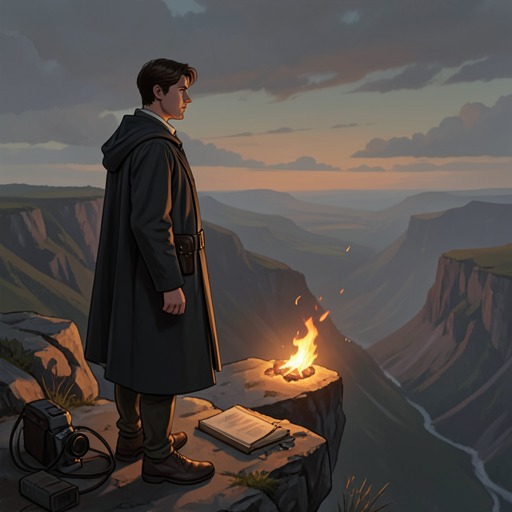
Seen from the summit of Sneffels, the crater resembles an inverted cone, with an opening roughly half a mile across and a bottom about five hundred feet in circumference. Its sloping sides make descent toward the bottom possible, but the scale of the hollow gives it a forbidding character. Henry Lawson compares it to an enormous loaded cannon, an image that turns the expedition’s intended route into a prospect of entering a dangerous, potentially active passage.
At the bottom, three separate shafts gape in the travelers’ path. They are the outlets of the central furnace, through which lava and poisonous vapors had emerged during eruptions when Sneffels was active. The openings are not interchangeable: the crater’s broad, exposed floor contains the choice that governs whether the expedition follows Saknussemm or loses the route. The contrast between the crater’s apparently gradual slope and its abrupt, deep shafts makes descent manageable in one respect but perilous in another.
Saknussemm’s Directions and the Shadow
The route is first conveyed through Saknussemm’s cryptogram. Its Latin directions tell the audacious traveler to descend into the crater of Yocul of Sneffels before the Kalends of July, promising that the center of the Earth will be reached. The message is signed by Arne Saknussemm and includes the declaration that he had already done it. Thus the crater is not merely a destination suggested by speculation: the document presents it as the entrance used by a predecessor.
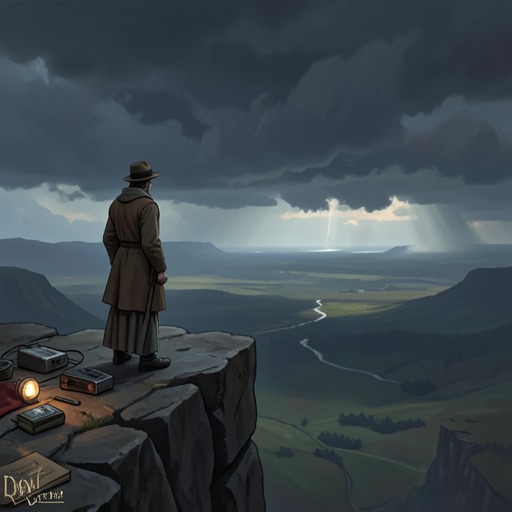
The cryptogram’s reference to Scartaris’s shadow supplies the means of distinguishing the correct shaft. As Professor Hardwigg explains, the shadow must fall upon and just touch the mouth of the proper opening in the last days of June. The peak functions like the stylus of a vast sundial, its moving shadow marking one particular aperture. This makes the expedition’s progress contingent on both a calendar and clear weather: with the party already at the crater on June 25, six more days of cloud would prevent the observation and postpone the attempt for another year.
When the sky clears, the shadow moves over the crater floor and, at noon, falls on the edge of the central pit. Professor Hardwigg recognizes this as the sign they have been waiting for and declares the route found. The moment resolves the uncertainty left by the three openings, but it does not remove the danger of entering one. The observation establishes which shaft to take; it cannot show the full conditions below.
The Descent and Its Risks
Henry approaches the selected opening with reluctance. He is unwilling to display more fear than Hans, whose calmness makes retreat difficult for him, and he thinks briefly of Gretchen before advancing. The shaft is about a hundred feet in diameter. When Henry leans over its rim, he loses his balance and is drawn back by Hans, whose intervention prevents him from falling. The episode establishes that the entrance demands physical caution before the descent has even begun.
The sides of the shaft are nearly perpendicular, but projections in the rock appear to offer footholds, making the opening resemble a steep natural staircase without a railing. Henry considers using a rope fastened near the surface, then notices a practical problem: once the party reached the bottom, the rope would have to be loosened above. The crater therefore confronts the travelers not only with danger but with logistical questions about how equipment can support a descent and still be recovered.
The selection of the shaft also shapes the expedition’s record of its own progress. After breakfast, Professor Hardwigg takes out a notebook intended for memoranda of the journey and begins an entry dated Monday, June 29. The decision to record the expedition’s observations places the crater within a larger process of measurement and documentation: the travelers act on Saknussemm’s text, observe the shadow, and preserve the journey as an ordered sequence of findings.
From Geological Threshold to Test of Knowledge
The crater’s significance extends beyond its role as an entrance. It concentrates the book’s recurring tension between received theories and what the expedition can observe. Later, when the party encounters temperatures that conflict with scientific expectations, Professor Hardwigg asks what the thermometer actually indicates and argues that the measured result challenges the established calculation. His response gives practical instruments and observed evidence authority over an abstract prediction; the crater had already required the party to rely on an observable shadow rather than guess among three openings.
That commitment to observation is not infallible. Elsewhere underground, a compass behaves erratically, its needle jumping between poles. Set beside the crater’s successful use of the sun’s shadow, the malfunction shows how instruments can guide the travelers but can also fail under extraordinary conditions. At Sneffels the sign is visible and decisive; later, the disturbed compass complicates confidence in the tools by which the party locates itself.
The crater’s threshold also opens into a world where familiar categories of time and life are unsettled. The party later examines a fish whose features distinguish it from a sturgeon and identify it, in Professor Hardwigg’s judgment, as belonging to a family known from Devonian fossils. The expedition’s later encounters, including the fossil evidence discussed in connection with the human jawbone found at Moulin-Quignon in 1863, extend the book’s questions about how physical remains become evidence for claims about the distant past. These later discoveries are not events in the crater itself, but they clarify the larger function of the descent that begins there: the chosen opening leads from a timed geological observation into an environment where direct observation repeatedly tests scientific classification.
The crater thus makes the expedition’s method visible in miniature. A cryptic document proposes a route; the calendar narrows the moment of action; the moving shadow selects one shaft; and the travelers’ bodies and equipment confront the risks that the sign cannot disclose. Sneffels crater is both the point of departure for the underground journey and its first demonstration that knowledge depends on reading the material world carefully, while remaining alert to the limits of any single observation.